NEW YORK, December 17, 2025 – SNAP condemns the Archdiocese of New York’s abuse settlement fund as a mechanism designed to block accountability through the courts, shielding church records from disclosure and church officials from sworn testimony. Under Cardinal Timothy Dolan, a $300 million fund uses desperately needed but inadequate compensation as damage control, capping liability and suppressing the full truth about decades of abuse and cover-up.
Throughout his career in St. Louis, Milwaukee, and New York, Cardinal Dolan has become known as a chief architect of strategies designed to withhold justice by sealing records, narrowing survivors’ access to the courts, and protecting church officials who facilitated abuse. That legacy is how he will be remembered by survivors.
The legal processes tied to these settlements compound survivors’ trauma – forcing them through prolonged, dehumanizing proceedings that prioritize the institution’s assets over human dignity. Survivors are reduced to claim numbers, their testimony constrained, and their pain negotiated behind closed doors. SNAP stands in unwavering solidarity with all those harmed in New York, those who participated in these processes and those who were shut out entirely.
Adding insult to injury, Cardinal Dolan now passes leadership to Bishop Ron Hicks of Joliet, Illinois, another Catholic leader with a documented record of concealing abuse, allowing accused predators to remain in ministry, and obstructing justice. This handoff underscores a pattern of continuity by the Vatican.
“No amount of money can repair the trauma inflicted by sexual abuse or decades of institutional cover-up,” said Angela Walker, SNAP’s Executive Director. “Courts must hold the Archdiocese of New York fully accountable under the law. Survivors deserve more than settlements – they deserve justice, transparency, and consequences for institutions that permitted clergy to commit devastating acts of sexual violence with impunity.”
NEW ORLEANS, December 8, 2025 – SNAP extends its deepest solidarity and support to all survivors of the Archdiocese of New Orleans, both those who participated in the bankruptcy proceedings and those whose voices were never heard in court.
The process remains profoundly unjust: it forces survivors to enter a bankruptcy arena as “creditors,” reducing the widespread rape and sexual assault of children, the extensive institutional cover-ups, and the financial manipulation that enabled these crimes to mere matters of debt. By removing these cases from the hands of justice officials and placing them before a bankruptcy judge, the church forces victims into a traumatizing, degrading, and drawn-out legal battle that severely limits their ability to seek reparations.
SNAP is encouraged that documents related to the archdiocese’s management of abuse claims will be made public, an essential step toward exposing the truth. We urge continued accountability for every official – Catholic or otherwise – whose actions allowed abusers to harm children and vulnerable people.
“There is no way to place a dollar amount on the devastation caused by abuse or the church’s long history of covering it up,” said Angela Walker, SNAP Executive Director. “We wish healing for every survivor, and we also know that the fight for justice must continue until the institution and all its enablers are fully held responsible.”
SNAP stands with all survivors of New Orleans today and every day.
In new audio recording, Diocese of Chiclayo calls pope’s investigation a “joke”
SNAP to file updated Vos estis lux mundi complaint using new evidence of cover-up
CHICAGO, December 4, 2025 – Survivors of clergy sexual abuse held a press conference to release new evidence showing Pope Leo XIV wielded his new papal authority to avoid testifying about his involvement in covering up child sex abuse in Peru.
This evidence included internal Vatican documents, emails from Pope Leo, and recordings of meetings with church officials discussing the cases of sexual abuse reported by Ana María Quispe Díaz and two other victims from the Diocese of Chiclayo in Peru.
Her full statement regarding the recent updates in her case can be found here.
Él no lo considera un delito / He doesn’t consider it a crime
On April 9, 2025, as Pope Francis’ prognosis was questionable following a five-week hospital stay, Fr. Giampiero Gambaro, OFM Cap., vice rector of the Universidad Católica Sedes Sapientiae, called Ana María Quispe Díaz and two other clergy abuse victims to a meeting at the Bishopric of Carabayllo in Lima on April 23rd. Gambaro, the delegate instructor appointed by the bishop of Chiclayo to carry out the administrative work in the canonical investigation into Quispe and the other victims’ reports, can be heard in newly released recordings of this meeting making several shocking claims about Cardinal Robert Francis Prevost, now Pope Leo XIV, and his management of their case.
In the April 23 meeting, taking place just two days after Francis’ death, Gambaro affirmed that one of the accused priests, Fr. Eleuterio Vásquez Gonzáles (Fr. Lute) had acknowledged the acts of abuse they reported, stating, “It may be that he considers it a sin. But he doesn’t consider it a crime.” (🎧Listen to audio with English transcription)
The “sins” in question include the following acts detailed in victims’ direct reports to Prevost:
In a 2022 in-person meeting with Prevost, Ana María Quispe Díaz and two other victims reported that when they were between the ages of 9-14 years old, Fr. Lute took off his clothes and, while making sexually inappropriate comments, touched his own genitals as well as the private areas of the victims on several separate occasions on mission trips to rural towns outside Chiclayo.
In a 2020 report made to Prevost by phone, Ana María Quispe Díaz alleged that Fr. Ricardo Yesquén Paiva kissed her on the mouth when she was 10-years-old, placing her on his lap and inserting his tongue, in the rectory of a parish in Chiclayo.
Despite assertions by Prevost that the accused priests ceased exercising public ministry, Facebook photos show that both Lute and Yesquén continued public ministry during Prevost’s tenure as Bishop of Chiclayo.
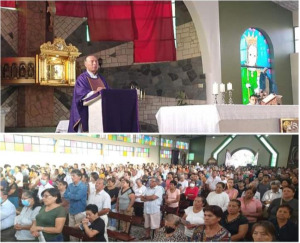
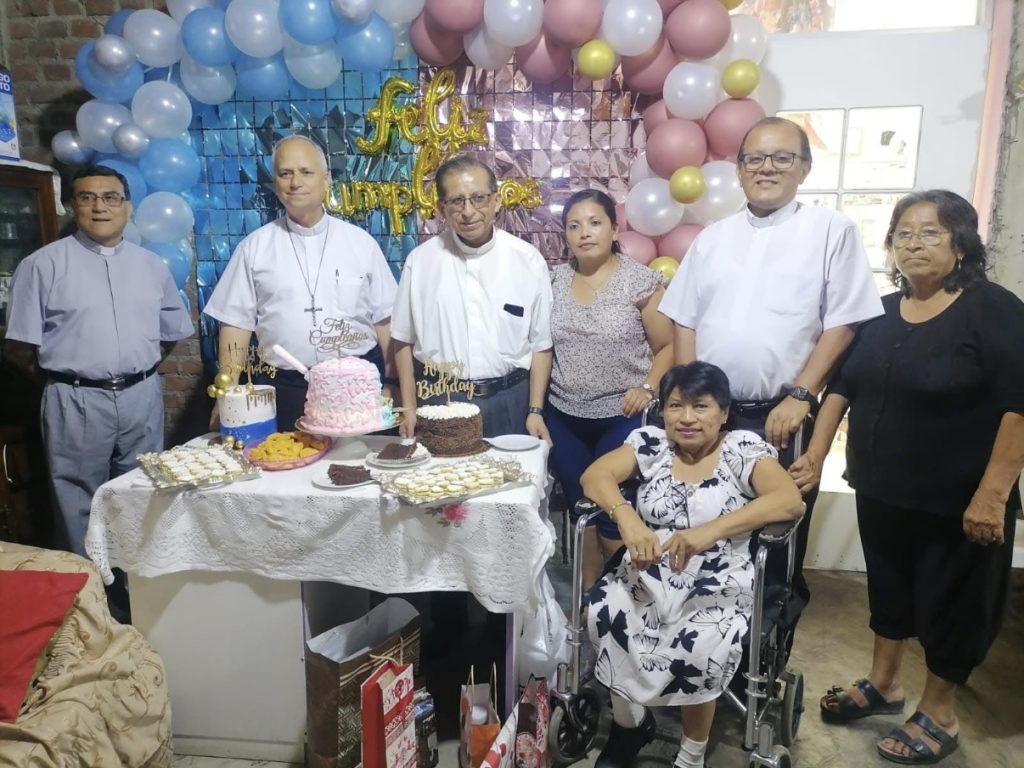
Lute leads a eucharistic celebration on March 26, 2023 at Parroquia San Jose Obrero, posted on the parish’s official Facebook pageIn a January 2023 photo posted on Facebook, Prevost can be seen standing next to Yesquén, dressed in clerical garb, at a birthday celebration for the priest accused of sexually assaulting a 10-year-old girl
Though most of the media reports surrounding Quispe’s case have focused on Lute, Yesquén also continued representing himself as a priest, despite statements by Prevost that he suffered from a debilitating physical and neurological condition that would have prevented him from exercising a proper defense in a canonical investigation. In an official statement from the Diocese of Chiclayo on September 10, 2024, responding to Quispe’s public statements, the church wrote, “Regarding the case of Father Ricardo Yesquén, due to the serious degenerative disease he suffers from, he is unable to defend himself, and therefore a case cannot be opened against him. He has not exercised the priestly ministry for years.”
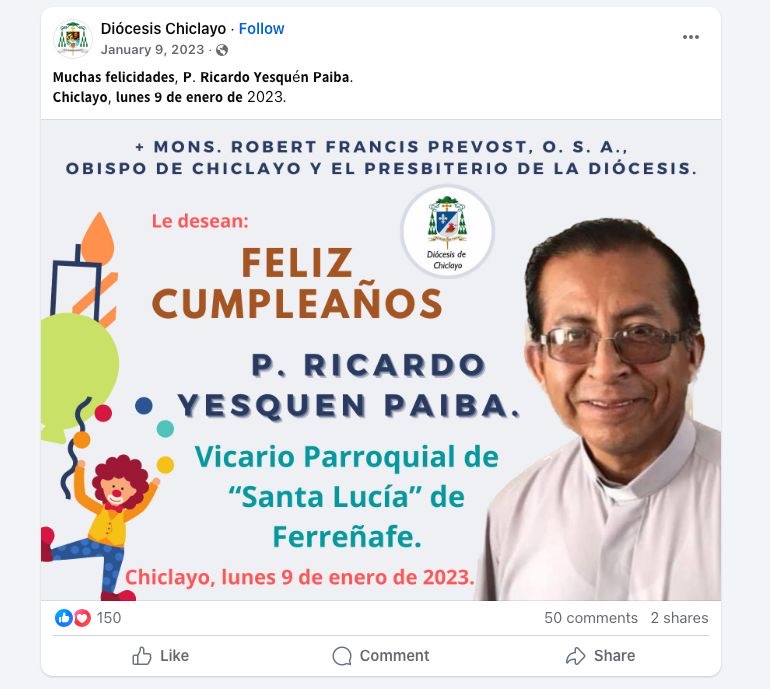
Contrary to the Diocese of Chiclayo’s claim that Yesquén had not exercised priestly ministry for years, a post from the official diocesan Facebook page wished Yesquén a happy birthday on behalf of Prevost, referring to him as the Parochial Vicar of Santa Lucía de Ferreñafe in January 2023.
According to the victim’s testimonies and available evidence, Prevost appears to have violated canon law quite significantly in his failure to initiate proper canon law proceedings into alleged crimes committed by both priests, offer canonical legal advice, procedural transparency, and spiritual and psychological support, and take effective precautionary measures to protect his diocese and the public from the potential dangers posed by Lute and Yesquén. Furthermore, his statement to the victims that a canonical investigation could not be initiated in the absence of a civil complaint is not consistent with canon law.
In the April 23 meeting, Gambaro characterized Prevost’s initial investigation of the victims’ claims as una tomadura de pelo, a “joke,” and admitted that SNAP’s March 25, 2025 filing of a Vos estis lux mundi report with the Vatican triggered the meeting, saying, “SNAP, in the wake of the conclave, to determine which cardinals should not be voted for as pope, included Prevost because of this case.”
Una tomadura de pelo / A joke
Gambaro went on to state that Prevost’s “preliminary investigation was very poorly conducted. The [Dicastery of the] Doctrine of the Faith claims that the case is closed, because the prosecution declared it was time-barred, that it had expired under Peruvian law…But the church’s statute of limitations is clearly quite different.”
Gambaro noted that this is an exceptional argument, saying, “This is the first time I’ve dealt with this type of situation where they invoke the statute of limitations under civil law in this way.” He adds that an unknown church official, believed by the victims to be Prevost, “signed a letter saying the [canonical] process should not be carried out.” (🎧Listen to audio with English transcription)
Calling Prevost’s investigation a “joke” in the presence of the three victims, Gambaro admitted, “They asked [Lute] practically nothing. He didn’t answer anything.” (🎧Listen to audio with English transcription)
These characterizations by the delegate instructor stand in stark contrast to public statements regarding Quispe and the other victims’ case by Prevost and other high-ranking Catholic officials.
In a July 15, 2024 email to InfoVaticana, shared with SNAP, Prevost responded to a question surrounding the reasoning behind Lute’s departure from his parish in Etén and relocation to Santa Cruz, writing, “This was one of the precautionary measures. Santa Cruz is the (civil) province where his family lives. He went to their home without publicly exercising his ministry.”
This claim is reiterated in an authorized Spanish-language biography, Pope Leo XIV: Global Citizen, Missionary of the 21st Century,authored by Elise Allen, a journalist who considers herself a friend of Prevost. Allen writes, “Father Vásquez Gonzales denied any abuse, claiming the situation was a misunderstanding. However, Bishop Prevost opened a preliminary investigation and imposed restrictions, banning him from public ministry and, consequently, from serving as a parish priest and hearing confessions, although he could still celebrate Mass privately.”
Not only is this reporting contradicted by Gambaro’s statements and the photos of Lute saying public mass posted on official diocesan Facebook pages during Prevost’s tenure in Chiclayo, Rev. Julio Ramírez, the priest tasked with overseeing the Diocese of Chiclayo’s “Listening Center” under Prevost’s leadership, told Quispe in a recorded phone conversation on November 11, 2023, “What Monsignor Roberto [Prevost] did was take him out of (Chiclayo) and leave him at his home in Santa Cruz…I’m not going to lie to you, it’s not that they took away his licenses. Monsignor Roberto’s only comment was that he shouldn’t come to Chiclayo.” (🎧Listen to audio with English transcription)
In another audio recording from March 2025, Gambaro can be heard explaining very clearly to the victims the very limited extent of Lute’s restrictions, confirming “Prevost’s decree of April 2022 states, (1) to prohibit Father Eleuterio from administering the sacrament of penance, (2) the exercise of the functions inherent to his office as parish priest in the parish of Santa María Magdalena, in the city of Etén, and nothing more, nothing more. It does not prohibit him from celebrating Mass, receiving it, or anything else.” (🎧Listen to audio with English transcription)
Buenas noticias/ Good news
In the April 23 meeting, Gambaro presented an update on Lute’s status to the victims, characterizing it as “good news,” stating that Lute had requested voluntary dispensation from the priesthood, citing the psychological exhaustion their accusations had caused him, framing Lute as a victim of the three women who reported he had abused them as young girls. Gambaro told the victims that this meant there would be no further investigation of the abuse.
In response, the victims requested two things:
A letter of apology for the handling of the case and public statements made by the diocese denigrating Ana María Quispe Díaz’s testimony
Financial reparations to cover the cost of psychological and psychiatric care – services that are required under Vos estis lux mundi, but were not provided to the victims prior to Prevost’s election in the May 2025 conclave.
Over the course of the next several months, Quispe and the other victims exchanged multiple letters with Gambaro and the Diocese of Chiclayo concerning the lack of public apology, the Diocese of Chiclayo’s instructions to avoid speaking to the press, severe delays in reimbursements for psychological care, and false statements made about the case by high-ranking Vatican officials.
Though the current Bishop of Chiclayo Edinson Farfán and other unnamed Vatican sources speaking to Crux have stated that the victims had received adequate psychological care through the Diocese of Chiclayo’s “Listening Center,” the diocese has since delayed promised payments for the victims’ psychological care – leading recently to a brief termination of services and medication.
On November 11, 2025, Gambaro wrote to Quispe and the other victims informing them that Lute had been granted voluntary dispensation on September 15, 2025. In his letter, he makes several statements that are at demonstrable odds with his characterization of aspects of the case in the April 23, 2025 meeting with the victims and canon law prescriptions.
In Quispe’s public response to this news, she states, “Granting a [dispensation] to Eleuterio Vásquez is also especially irresponsible given that there are witnesses who have publicly stated to the media that he frequently took other children to the same room where we were abused. That information, which should have triggered every alarm, demanded a deep and urgent investigation — not the definitive closure of the case.”
Gambaro astonishingly claims that the “receipt and handling of the complaints” have followed canon law. One might ask – does Gambaro believe that an investigation in which the accused is not compelled to answer basic questions about allegations, one that he himself called a “joke” – is canonically sanctioned?
With no acknowledgement of the anxiety and emotional pain produced by the diocese’s delays in reimbursing the costs of psychological and psychiatric care, detailed in the six letters victims sent to the Diocese of Chiclayo in September and October, Gambaro claims that the diocese is fulfilling its duty under canon law for the “well-being” of the victims.
Finally, Gambaro frames Lute’s dispensation as a loss of “dignity” and “rights,” implying, as he did in the April 23 meeting that this is a punishment for Lute though he has been granted an “honorary discharge” from the priesthood with no trial, no finding of guilt, and no public record of his crimes.
Most significantly, the only person in the 1.4 billion member Catholic Church empowered to sign off on this dispensation, is the man who stands to lose the most by an investigation and trial: Pope Leo himself, who serves as both judge and interested party in a case that directly implicates his own oversight.
Creí…que querías que renunciara / I thought…you wanted me to resign
Pope Leo revealed to Elise Allen in his authorized biography that he understood his vulnerability in this case from Chiclayo and that it caused him a significant amount of anxiety leading up to the conclave.
In Pope Leo XIV : Global Citizen, Missionary of the 21st Century, the new pontiff recounted to Allen his anxiety leading up to the conclave. He first describes a meeting with Pope Francis immediately following SNAP’s Vos estis lux mundi complaint saying, “I received a phone call asking me to go secretly to Santa Marta, and they told me, “Don’t tell anyone.” The Pope wanted to see me. And they didn’t tell me anything else. So I didn’t tell anyone in the office, not my secretary, not anyone. I simply disappeared and went. I went up the service stairs, and no one saw me. Then, after he’d told me what he wanted, which concerned work, bishops, and other matters he had in mind, I said to him, “For your information, Holy Father, I thought that perhaps the reason you called me that way was because you wanted me to resign.”
Pope Leo further acknowledged that his handling of the aforementioned abuse cases in Chiclayo were a cause for concern with other Catholic cardinals, telling Allen, “But I also thought about the case you asked me about before [the one of the complaints in Chiclayo, which worried some of the other cardinals, whether this issue of sexual abuse could be a problem.”
In an August 2, 2025 email, just two days after Quispe spoke at a press conference in Chicago “for herself, for her family…and for children in danger” calling for justice, Pope Leo wrote to InfoVaticana regarding her case. He begins by saying, “Against all the advice I’ve been given, I’ll answer the main question briefly.” This question pertained to his alleged knowledge of an email sent by Quispe to request information about her case to be corrected on InfoVaticana’s website. On the eve of the conclave, the reporter described a conversation with Prevost in which this email was mentioned.
This reporter later wrote, “What surprised me, Your Holiness, was that you were already aware of that email just a few hours after it arrived. No one else knew about it. And it was you yourself who, in that brief but difficult encounter we had at the entrance to the Holy Office, made explicit reference to its contents. Since then, I haven’t been able to stop wondering how it came into your possession and why.”
Pope Leo denied knowledge of the email, but wrote that “recent events,” implying Quispe’s public advocacy, “will only cause her more harm, because they continue the revictimization of someone who is seeking peace and healing.” He continued, “I believe that the insistence on publishing the same stories over and over again only harms Ana María and [the other victims].” Despite these comments that ignored Quispe’s agency and thoughtful decision to speak publicly, painting her rudderless and impressionable, the pontiff spoke at length about Quispe’s case in interviews with Elise Allen that were published in his authorized biography the following month.
Conclusion
SNAP will file a updated Vos estis lux mundi complaint next week with the Dicastery for the Doctrine of the Faith and other Vatican and civil authorities, including the American and Peruvian ambassadors to the Holy See and the UN Committee on the Rights of the Child, urging a full investigation into Pope Leo XIV’s role in authorizing the voluntary dispensation of Lute and suppressing the Chiclayo case. This case from Chiclayo is not isolated, and sadly, not unique – it exposes a system that allows bishops and cardinals to control and close cases that implicate themselves.
For this reason survivors have insisted on a binding, universal zero tolerance law that would eliminate the structures that allow the Catholic hierarchy to cover-up abuse and shield offenders with impunity.
This afternoon, the United States Conference of Catholic Bishops (USCCB) selected Oklahoma City Archbishop Paul Coakley as their next president.
“While it is not surprising that the USCCB has once again chosen a leader who has kept known abusers in ministry and misled Catholic families, survivors are furious that the U.S. bishops will take direction from a man with a history of minimizing criminal sexual assault and endangering the public,” said SNAP Board President Shaun Dougherty.
In 2016, SNAP criticized Coakley after he issued a statement justifying his assignment of Father José Davila to a parish, five years after Davila entered a guilty plea for three counts of sexual battery of a 19-year-old woman in his home. San Diego prosecutors charged Davila when the victim alleged he touched her buttocks, put his finger in her vagina, and touched her left breast against her will.
In his statement, Coakley argued Davila had “accepted the consequences of his lack of judgement” and that Davila understood his “actions were perceived as inappropriate.”
Coakley only removed the priest after widespread public outrage from Oklahoma Catholics and abuse survivors, citing vague “new information” he refused to disclose.
During his tenure as Archbishop of Oklahoma City, Coakley allowed at least two priests later identified as “credibly accused” by the archdiocese to serve in parishes without any apparent restrictions on their ministry.
Father Benjamin Zoeller was laicized in 2011 for abuse of a minor. A victim from Minnesota contacted the archdiocese in 2018, shocked and outraged that Zoeller was permitted to serve as a volunteer in one of Coakley’s parishes. The victim’s brother had previously contacted the archdiocese in 2006 regarding Zoeller.
A victim filed a lawsuit against Father James Mickus in 2002 after reporting his rape and sexual abuse to the Archdiocese of Oklahoma City through a hotline. Mickus was investigated and reinstated by the archdiocese, serving at more than a dozen parishes across the Oklahoma City metro area. Under Coakley’s leadership, Mickus served almost eight years until he was removed in 2018.
“Today’s announcement only reinforces what we already know: survivors waiting for justice should not look to the USCCB,” said Peter Isely, a longtime spokesperson and activist with SNAP. “Only public exposure and action on the part of civil society will force the U.S. bishops to remove offenders and disclose the vast amount of criminal evidence of rape and sexual assault in their possession.”
SEATTLE – The Survivors Network of Those Abused by Priests (SNAP) condemns in the strongest possible terms the decision by Washington State officials to exempt clergy from the state’s mandatory reporting law, allowing religious officials to withhold knowledge of child rape and sexual assault when learned in the confessional.
“This is a shameful day in Washington’s history,” said SNAP spokesperson Sarah Pearson. “Governor Ferguson and Attorney General Brown have bypassed the legislature to appease powerful church lobbyists. They have chosen to protect the institutional church instead of children, survivors, and the vulnerable.”
SNAP called the move a “devastating betrayal” of public trust, warning that the exemption creates a dangerous double standard. “Every teacher, doctor, therapist, and social worker in Washington is required by law to report suspected abuse,” the group noted. “But clergy are now given a license to conceal rape and sexual assault. There is no compromise when it comes to child sexual abuse.”
Mary Dispenza is SNAP’s Washington State Leader and is herself a survivor of clergy sexual abuse.
“When I was 18, I reported my abuse to a priest during confession,” said Dispenza. That priest never reported my abuser to law enforcement. My abuser continued assaulting little girls for four decades. With a law like this in place, someone could have been held accountable. Other little girls could have been saved from abuse. Instead, our government has given the church permission to continue to conceal abuse.”
SNAP urges Washington lawmakers and citizens to demand the reinstatement of full clergy reporting requirements and to hold both church and state officials accountable for protecting abusers over children.
“Rather than fight for what’s right, state leadership has backed down,” Pearson said. “They have allowed bishops and clergy to dictate public safety and abdicated their responsibility to protect the most vulnerable.”
September 26, 2025 — Today, the Vatican announced that Pope Leo XIV has appointed Archbishop Filippo Iannone, prefect of the Dicastery for Legislative Texts, to head the Dicastery for Bishops.
Peter Isely, SNAP’s Global Advocacy Chair said:
“Iannone’s promotion sends a chilling message to abuse victims around the world, not only to expect advancement toward zero tolerance to be blocked, but a rollback on the hard-fought progress of clergy abuse survivors and advocates over the years. It was Iannone who shaped the church law on sexual abuse to guarantee that zero tolerance for abusers, and accountability for the bishops who covered it up, would never be included. Leo is putting the oversight and management of bishops in the hands of a man who has fought to enshrine the concealment of abusers in Vatican policy.”
This announcement comes just one week after Leo used his first public interview to redirect the conversation on abuse to “false accusations” and “priests’ rights” after throwing cold water on any hope for a zero tolerance law that would permanently remove abusers from ministry and institute a mechanism by which bishops could be held responsible for facilitating and concealing abuse.
As head of the Dicastery for Legislative Texts, Iannone took significant actions to stop progress toward zero tolerance:
He “updated” descriptions of criminal abuse in church law to ensure priests could not be subjected to a mandatory zero tolerance law for sexual abuse. Such a law would require the permanent removal from ministry or the priesthood of any cleric proven to have raped or sexually assaulted children or vulnerable adults.
Earlier this year, the Dicastery for Legislative Texts instructed bishops to avoid publishing news that could damage the reputation of priests accused of rape and sexual assault, emphasizing the potential to harm their “good reputation” and privacy, even in cases where the church possesses ample evidence of sex crimes and their concealment from the public.
In response to the Independent Inquiry into Child Sex Abuse (IICSA) of England and Wales, the English and Welsh bishops wrote to the Vatican in 2021 requesting a removal of language in canon law defining the rape and sexual assault of children as a violation of the Sixth Commandment (“Thou Shalt Not Commit Adultery”). The Pontifical Council for Legislative Texts refused to remove this language, continuing to define child victims of rape and sexual abuse as co-conspirators in adultery.
The pope’s appointment of Iannone to one of the Vatican’s most powerful dicasteries underscores why survivors cannot rely on Pope Leo to reform the Vatican. Civil governments and the international community must act to hold the Holy See accountable for the grave human rights violations identified by the UN Committee on the Rights of the Child and the UN Committee against Torture. Without external accountability, under Pope Leo’s leadership, the Vatican will continue to shield predators, deny justice to survivors, and endanger future generations.
The Survivors Network of those Abused by Priests (SNAP) is appalled by Quincy Mayor Thomas Koch’s recent comments on WBZ News Radio1030 dismissing the clergy abuse crisis as “mostly homosexual issues” rather than recognizing the catastrophe for what it is: the widespread and systemic rape and sexual assault of children and vulnerable people facilitated and concealed by Catholic bishops around the world.
The conflation of homosexuality and pedophilia has been repeatedly refuted by medical and scientific experts. Mayor Koch’s comments serve to scapegoat gay men, imply that middle-school and high-school boys are not actually victims of abuse, and completely dismiss every girl or woman who has been assaulted in the Catholic Church.
Perhaps no diocese in the United States has drawn as much global attention for the rampant sexual abuse of children, and its cover-up by church leaders, as Boston. Even so, an AP investigation found that no U.S. diocese had omitted more accused priests from public disclosure than the Archdiocese of Boston.
For Mayor Koch to deny that reality while the children of Quincy go to schools and parishes run by the Archdiocese of Boston is a disservice to his community and an insult to every survivor of clergy sexual abuse in Quincy and beyond. For this, he should apologize.
The Survivors Network of those Abused by Priests (SNAP) strongly condemns the John Templeton Foundation’s decision to award its 2025 Templeton Prize to Ecumenical Patriarch Bartholomew tomorrow in New York. The foundation praised Bartholomew’s “ecumenical imperative” to care for all of creation, but survivors ask: how does this imperative extend to victims of sexual abuse within his own church?
“Is it not Patriarch Bartholomew’s ‘ecumenical imperative’ to tell the truth about abuse in his own church? To stop standing in the way of justice? To take steps to ensure this never happens again?” said Dr. Hermina Nedelescu, an advocate for victims in the Orthodox Church and keynote speaker at SNAP’s 2025 Annual Conference.
Patriarch Bartholomew’s refusal to remove all known offenders from ministry and discipline bishops and church leaders for facilitating and concealing abuse is a profound moral failure that poses an ongoing public safety threat to the Orthodox community. Such a refusal should disqualify him from receiving an honor that purports to celebrate spiritual leadership and human dignity.
By rewarding Bartholomew, the Templeton Foundation is not only overlooking these failures, it is actively causing harm to survivors by honoring a figure who has stood in the way of justice for those who were raped and sexually abused in his church.
By Dan McNevin, Board Treasurer, Survivors Network of those Abused by Priests (SNAP)
In his recent community letter, Bishop Barber accused survivors of sexual abuse of “racing to the courthouse steps,” a remark that cruelly distorts their motives and heaps fresh insult on their pain. Nothing could be further from the truth. Survivors are not after profit, they are fighting for justice, dignity, and the truth.
The reality is that the Diocese of Oakland is far from poor. Bishop Barber resides in a 4,000-square-foot apartment in a $200 million cathedral complex, while the diocese controls more than 80 parish campuses, cemetery land in Lafayette, and other valuable East Bay properties. Court records from the bankruptcy reveal hundreds of millions in cash, investments, and real estate holdings. If these assets were valued as residential land, Bishop Barber would be considered a billionaire – one of the richest men in America.
Meanwhile, survivors, many of whom struggle to pay rent, afford medication, or keep up with student loans, continue to suffer. Who is really being selfish here: the bishop with a billion-dollar portfolio, or the 345 individuals seeking fair restitution for sex crimes committed against them as children?
Instead of addressing these crimes with honesty and compassion, Bishop Barber has spent more than $30 million on lawyers to prevent justice and conceal the truth. His list of “credibly accused” priests contains only 65 names, when the real number is more than twice that.
This bankruptcy isn’t only about money for past crimes. It’s about justice, and it’s about the future. The church cannot be safe until the full truth is revealed about how Bishop Barber and his predecessors concealed child sexual abuse. It cannot be safe until laws ensure it never happens again. Bishop Barber must come clean, and he needs to pay what he owes.
Sincerely, Dan McNevin Clergy Abuse Survivors and Board Treasurer
Survivors Network of those Abused by Priests (SNAP)
Pope Leo’s emphasis on “false accusations” and “priests’ rights” in his first public interview, comes in the face of damning evidence of his own failure to follow canon law and the Peruvian bishops’ abuse policy. His record shows not just ignorance or insensitivity, but a rejection of zero tolerance for sexual violence and cover-up at the very moment he claims to uphold it.
The message to abuse survivors is to expect the status quo: a church that continues to shield known offenders, refuses to discipline bishops who facilitate abuse by keeping rapists and abusers in power, and a church that will use every tool at their disposal to preserve this system.
SNAP Board President Shaun Dougherty responds:
“We wouldn’t have to keep focusing on this crisis if Pope Leo would just do the right thing. Enact a global zero tolerance law, release the criminal evidence in the Vatican archives, and stop spending millions on attorneys and lobbyists to fight every effort to pass laws that allow survivors to seek justice. Until these basic steps are taken, the pope’s continued failure to act will ensure that this crisis remains front and center, as it should.
When Pope Leo says not to expect major reforms, it is a rejection of survivors. It’s an abandonment of children by the church. The failure to stop abuse, to remove offenders from positions where they can continue committing sexual violence, is not just a moral failure – it’s a death sentence. We’ve lost too many friends to suicide and despair.“
SNAP Global Advocacy ChairPeter Isely adds:
“What the world needs – and what survivors desperately need – is a binding and universal zero tolerance church law that upholds the fundamental human rights and protections of children and others against rape, sexual assault and abuse by clergy. The Catholic Church has created a global catastrophe through its careful maintenance of a system that has allowed clergy to abuse children and vulnerable people around the world with impunity. The Vatican has ignored every major international call for accountability, including from the UN Committee on the Rights of the Child and the UN Committee Against Torture.”
The Holy See has since failed to implement the CRC’s 2014 recommendations which include canon law reform, an “independent mechanism” for monitoring children’s rights and the “conduct of the Catholic hierarchy” in managing sexual abuse, “transparent sharing” of archives related to management of sexual abuse, and immediate removal of child sexual abusers from ministry.
SNAP Spokesperson Sarah Pearson adds:
“Survivors brought their evidence to the highest international bodies, and those bodies affirmed what we’ve known for decades: that the Catholic Church has perpetrated and perpetuated widespread sexual violence amounting to torture. When Pope Leo says not to expect any major reforms regarding church doctrine related to sexuality, he is saying, ‘Let’s leave this system in place.’”
On the day of Pope Leo’s election, SNAP said to the new pope, “You can end the abuse crisis – the only question is, will you?” Pope Leo has given us his answer.